What Is a Reaction Time Test?
Reaction time tests measure the time difference — in milliseconds — between a stimulus appearing on the screen and your physical reaction to it. The speed at which you click or tap after a visual cue is what we measure.
This kind of test is sometimes called a reflex test or click reaction test. It isolates one particular cognitive skill — how quickly your brain processes incoming information and sends a signal to your muscles to act.
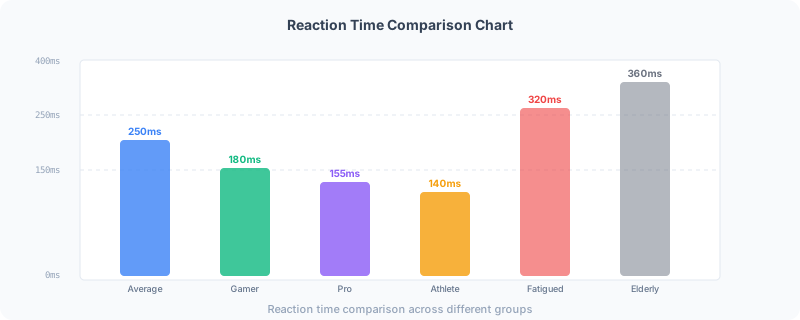
But reaction time is more than physical speed. It's a window into your nervous system, your level of focus, your mental sharpness — and even how rested you are. Scientists have been studying human reaction time for more than a century. The findings are consistent: the average person responds in 200-300 milliseconds. Elite athletes and top esports players regularly achieve results under 180ms.
How Does the Reaction Time Test Work?
Our online reaction speed test is simple by design. A colour on your screen changes from red to green. When you see that change, you click or tap as fast as you can. We measure the time between the colour change and your click — to the millisecond.
The tool employs a random delay before the signal appears, so you cannot predict when it will come. This ensures your score reflects your real reaction speed and not anticipation. Each attempt gives you an instant result. Run multiple rounds to find your average and track improvement over time.
Why Is Reaction Time Important?
Reaction speed isn't just a gaming stat. It shapes outcomes in a wide range of real-life situations.
🎮 Gaming Performance
In competitive FPS games like CS2, Valorant, and Apex Legends, the player who reacts faster wins the duel. 150ms vs 250ms may not sound dramatic, but at a professional level, that 100ms gap is the whole game.
🚗 Driving Safety
A driver at 60mph travels about 88 feet per second. A 200ms delay means your car travels 17 feet before your foot even hits the brake. Faster reflexes mean shorter stopping distances.
⚽ Sports Performance
Sprinters, tennis players, boxers, and goalkeepers all rely on sub-250ms reactions. Coaches use reflex tests to monitor athletes and tailor conditioning programs.
🧠 Daily Life
Catching a falling object, navigating a crowded street, responding to sudden sounds — everyday life calls on your reflexes. People with sharper reaction times feel more alert and in control.
Average Human Reaction Time
Where do you fall on the spectrum? Here's a reference based on research into human visual reaction times:
| Category | Reaction Time | What It Means |
|---|---|---|
| Excellent | Under 150ms | Elite athlete / top esports player |
| Very Good | 150ms – 200ms | Above average; competitive gaming-ready |
| Average | 200ms – 250ms | Typical healthy adult |
| Below Average | 250ms – 350ms | May benefit from training or rest |
| Slow | Over 350ms | Possibly fatigued or needs practice |
How to Take Our Reaction Time Test
Get Ready
Open reactiontimetest.live on any device. No signup or download needed.
Wait for the Signal
The screen will change colour after a random delay. Don't click early — that's a false start.
Click Instantly
The moment the signal appears, click or tap immediately.
See Your Result
Your reaction time in milliseconds appears instantly.
Repeat for Accuracy
Take at least 5 attempts and check your average. A single result can be skewed by momentary distraction.
Features of Our Reaction Time Test Tool
⚡ Instant Results
No waiting. Your millisecond score appears the moment you click.
🎯 Millisecond Accuracy
High-resolution performance.now() timing API for precise measurements.
📱 Mobile Friendly
Works flawlessly on phones, tablets, and desktops.
♾️ Unlimited Attempts
Test as many times as you like. Track improvement over days or weeks.
🔓 No Registration
No email, no account. Just open the site and start testing.
💰 Free Forever
No premium tier. No paywalled features. Free for everyone.
Factors That Affect Reaction Time
Your reflexes aren't fixed. Many variables influence how fast — or slow — your reaction time is on any given day.
Age
Reflexes are fastest in your twenties, then begin slowing. Reaction time gets slower by about 10ms every decade after your mid-20s, but trained people deteriorate much more slowly.
Sleep
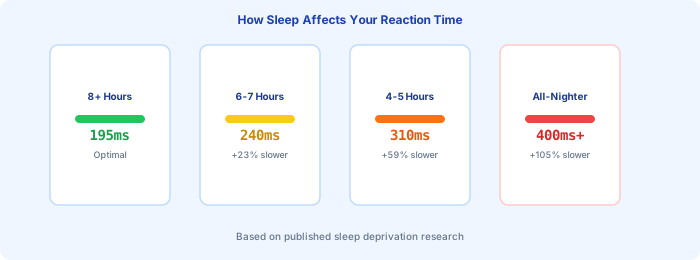
Even slight sleep deprivation (1-2 hours lost) can make reaction times 20% slower. Being awake 17-19 hours is equivalent to a blood alcohol content of 0.05%.
Focus & Distraction
Testing while watching TV or checking your phone won't reflect your true speed. A quiet, focused state gives the most accurate result.
Stress
Short-term stress can sharpen reactions, but chronic stress disrupts the nervous system and slows reflex responses over time.
Practice
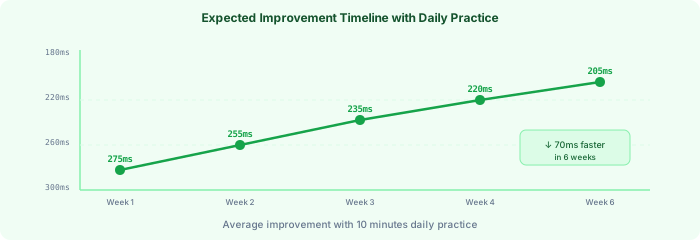
Reaction time is trainable. Regular testing, aim training games, and sports drills can meaningfully improve how fast your brain responds.
Device Performance
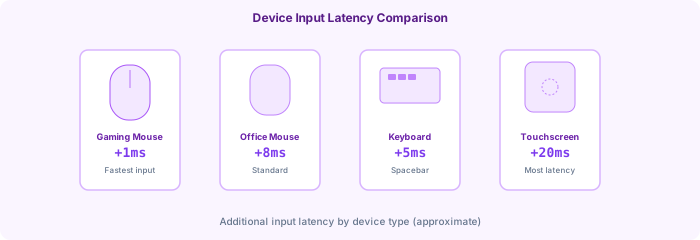
A 144Hz monitor reduces visual latency vs 60Hz. A gaming mouse with faster polling rate responds more precisely. Hardware matters.
How to Improve Your Reaction Time
- ✓Train consistently. Use our tool daily. Tracking your baseline over time shows real improvement.
- ✓Try aim trainers. Tools like Aim Lab and KovaaK's sharpen gaming reflexes with pattern recognition exercises.
- ✓Play fast-paced games. Action games force your brain to process fast-moving visual information constantly.
- ✓Improve your sleep. A well-rested brain reacts faster. Prioritize 7–9 hours of quality sleep.
- ✓Exercise regularly. Cardiovascular exercise increases blood flow to the brain, supporting faster neural processing.
- ✓Stay hydrated. Even mild dehydration can slow reaction time by 5–10%.
- ✓Practice mindfulness. Better focus = faster reactions. Meditation improves the concentration needed to react at full speed.
Reaction Time Test for Gamers
If you play competitively, your reaction time is your edge. In FPS games, the time between seeing an enemy and clicking your mouse is your visual reaction time. Every millisecond you shave off increases your chance of winning gunfights. Most pro players have reaction times between 150ms and 200ms.
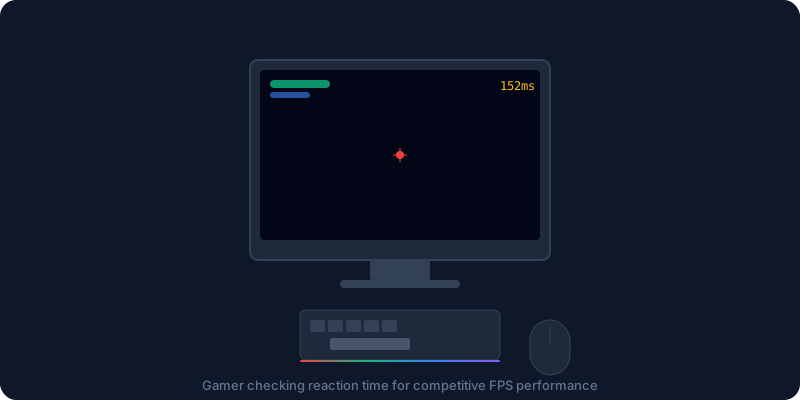
Esports organizations now routinely measure reflex speed as part of player assessment. Coaches use online reaction tests to identify fatigue, track performance dips, compare training cohorts, and set measurable improvement targets.
💡 Pro tip: Benchmark your reaction time before and after long sessions. If your numbers drop significantly after 2–3 hours, that's your cue to take a break.
Reaction Time Test for Athletes
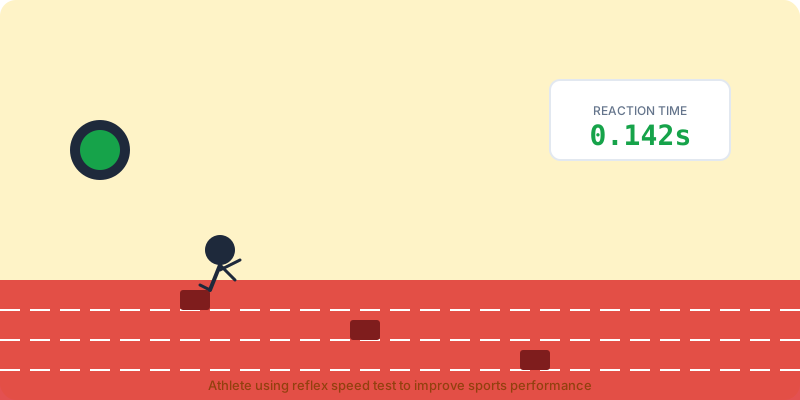
Reaction time is a physical skill, not just a mental one. It determines whether a sprinter reacts to the gun fast enough, whether a goalkeeper dives the right direction, whether a boxer slips a punch, and whether a cricketer plays a delivery on time.
Athletes should test both when fresh and when tired to determine the effect of fatigue on individual performance. Sports institutions conduct reflex tests quarterly as a means of assessing growth and detecting burnout.
Reaction Time Test vs Human Benchmark
| Feature | ReactionTimeTest.live | Human Benchmark |
|---|---|---|
| Millisecond accuracy | High-resolution API | Standard timing |
| Mobile optimized | Fully responsive | Partially |
| No registration | Yes | Account needed |
| Unlimited attempts | Yes | Limited free |
| Privacy | No tracking | Data retained |
| Ads | None | Ad-supported |
Benefits of Testing Regularly
- •Track genuine progress over days, weeks, and months
- •Identify performance dips caused by fatigue, illness, or poor sleep
- •Motivate training with a concrete, measurable number to beat
- •Understand your baseline so you know what "normal" looks like for you
- •Make better decisions about when to compete and when to rest
Common Mistakes During a Reaction Test
❌ Clicking before the signal. This registers as a false start. Wait for the actual cue.
❌ Testing while distracted. Multitasking gives you a slower, inaccurate score.
❌ Taking only one attempt. A single result is noisy. Always run at least 5 attempts.
❌ Testing on a loaded device. Background processes may add lag. Close unnecessary tabs.
❌ Comparing across devices. A mouse on a 144Hz monitor records faster than a tap on an older phone.
Scientific Facts About Human Reflexes
- 🔬The minimum measurable reaction time for humans is about 100ms — attainable by only a small percentage of trained individuals.
- 🧠The visual process travels from eyes → optic nerve → visual cortex → motor cortex → muscles, all in less than 0.25 seconds.
- 🎮Studies confirm gamers have significantly faster reaction times than non-gamers across all age categories.
- ☕Caffeine improves reaction time by about 11ms at optimal levels (approximately 200mg).
- 📉Reaction time slows by about 10ms every decade after your mid-20s, but trained people deteriorate much more slowly.
Who Should Use This Tool?
Reaction Time by Age: What to Expect
Reaction time changes throughout your lifespan. Understanding your age group's typical range helps set realistic benchmarks and training goals.
| Age Group | Avg Reaction Time | Notes |
|---|---|---|
| 10–17 years | 250–280ms | Developing nervous system; improves rapidly with age |
| 18–24 years | 190–220ms | Peak reaction time period for most people |
| 25–35 years | 200–240ms | Still near peak; minimal decline with training |
| 36–50 years | 220–270ms | Gradual slowing; exercise helps maintain speed |
| 51–65 years | 250–320ms | Noticeable decline; regular training slows deterioration |
| 65+ years | 280–400ms | Significant variability; active individuals perform better |
Note: These are averages based on published research. Individual results vary significantly based on lifestyle, training, and health. Trained individuals in any age group consistently outperform untrained peers.
How Your Brain Processes Reaction Time
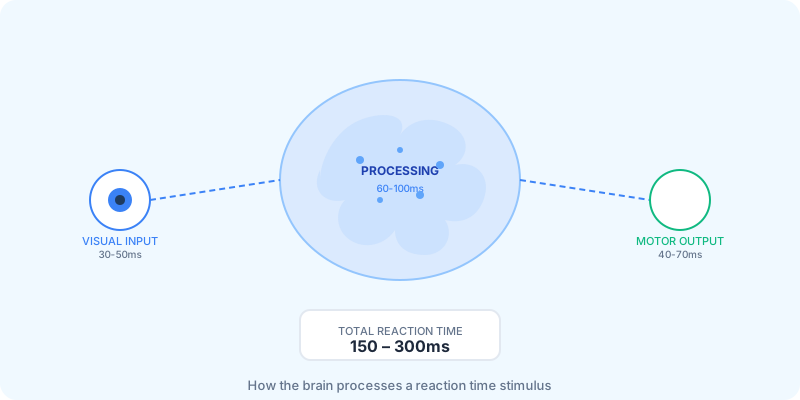
When you take a reaction time test, a complex chain of neurological events occurs in under a quarter of a second. Understanding this process helps explain why certain factors speed up or slow down your responses.
Step 1: Visual Detection (30-50ms)
Light hits your retina. Photoreceptor cells convert photons into electrical signals and send them through the optic nerve.
Step 2: Visual Processing (40-60ms)
The visual cortex at the back of your brain identifies the colour change. Pattern recognition kicks in.
Step 3: Decision Making (20-40ms)
The prefrontal cortex decides to act. In a simple reaction test, this decision is pre-loaded, making it faster than choice reactions.
Step 4: Motor Response (40-70ms)
The motor cortex fires signals down the spinal cord to your finger muscles. The click happens.
The total time from photon hitting retina to finger clicking takes approximately 150-300ms in most adults. Training reduces each step by optimizing neural pathways through repetition — a process neuroscientists call myelination.
Reaction Time Requirements Across Game Genres
Different game genres demand different levels of reaction speed. Here is how reaction time impacts performance across the most popular competitive games:
🔫 FPS (CS2, Valorant, Apex)
Required: 140-200ms. The time between seeing an enemy and firing determines who wins the gunfight. Pro players flick and fire in under 180ms consistently.
Importance: Critical
🏎️ Racing (F1, iRacing)
Required: 150-220ms. Reacting to overtake opportunities, crashes ahead, and flag signals. Milliseconds determine podium positions.
Importance: Very High
⚔️ Fighting (Street Fighter, Tekken)
Required: 160-250ms. Blocking incoming attacks, confirming combos on hit, and punishing whiffed moves all demand sharp reactions.
Importance: High
🏰 MOBA (League, Dota 2)
Required: 200-300ms. Dodging skillshots, flashing abilities, and reacting to ganks. Slightly more forgiving than FPS but still matters at high ranks.
Importance: Moderate-High
Optimal Daily Routine for Peak Reaction Time
Want to consistently hit your fastest reaction times? Here is a science-backed daily routine used by esports professionals and competitive athletes:
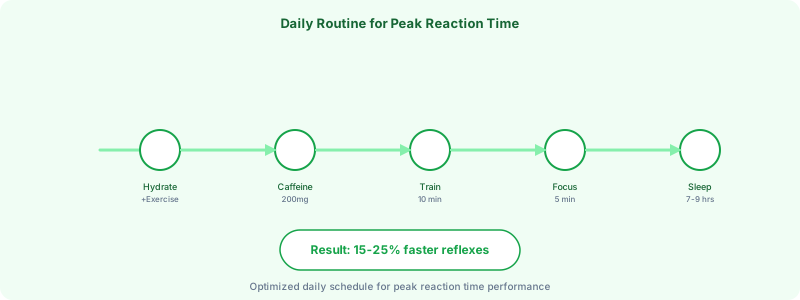
Morning: Hydrate + Light Exercise
Drink 500ml water upon waking. 15-20 minutes of light cardio increases brain blood flow by 20%.
Pre-Session: Strategic Caffeine
100-200mg caffeine 30 minutes before testing. Research shows this improves reaction time by ~11ms.
Training: 10 Minutes of Reaction Drills
5 warmup clicks, then 10-15 measured attempts. Record your average. Use our tool daily for tracking.
Focus: 5-Minute Mindfulness
Brief meditation before gaming sessions sharpens attention and reduces anticipation errors.
Night: 7-9 Hours Quality Sleep
Sleep is when your brain consolidates neural pathways. Skipping sleep can add 30-50ms to reaction time.
Why Choose reactiontimetest.live?
We built this tool because we wanted something better than what was available: fast, clean, honest, and free.
Fast Loading
Page loads in under a second, even on slower connections. Lightweight and optimized.
Accurate Results
High-resolution timing APIs — not basic Date.now() — for measurements you can trust.
Privacy Friendly
We don't store your results on our servers. No tracking. No email required. Data stays on your device.
Clean Interface
No pop-up ads. No distracting banners. Just you, the test, and your score.
No Downloads
Works entirely in your browser. Nothing to install. Open and test.
Unlimited Tests
Test once or test a hundred times. No paywall between you and your data.
Our Other Tools
Check out our other free online tools designed to help you with everyday tasks:
Conclusion
Your reaction time is a real, measurable part of your performance — whether you are competing in esports, training for a sport, or just curious about your own brain. The numbers do not lie. And they can improve.
reactiontimetest.live gives you an instant, accurate, completely free way to measure your reaction time, track progress, and push your reflexes to the next level. No signups. No ads. No friction.
Take the test now. Find out where you stand. Then beat your score.